
Thailand & the Lahu People
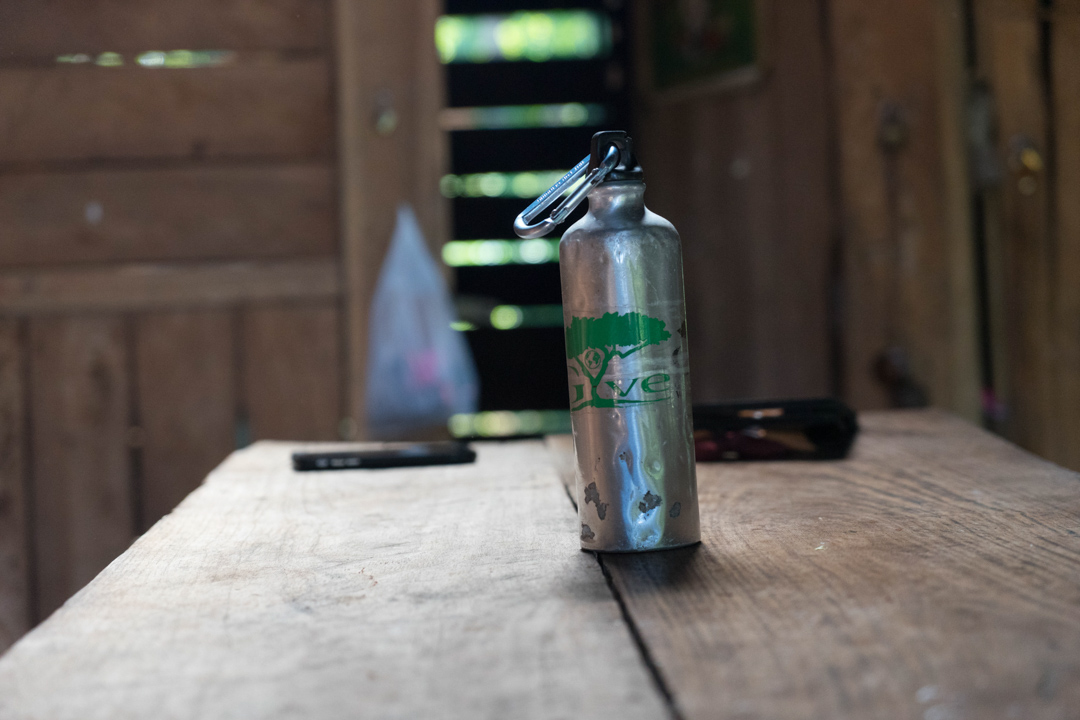
Two trips to Thailand in two years. Veronika typically only wants to visit a country once, get the passport stamp and move on! But Thailand is special. The first trip we flew in from Vietnam, to meet Jon and Rachel for lunch in Bangkok. That’s a long way to travel for some Pad Thai. They were coming in from the coast of Thailand. They went on from there to Chiang Mai, to volunteer with the Give Volunteer organization. That trip and Give had a huge positive impact on Jon. It opened him up to people of the world. He became a true global citizen. I can’t say enough about travel, and especially meaningful travel with a great organization like Give.
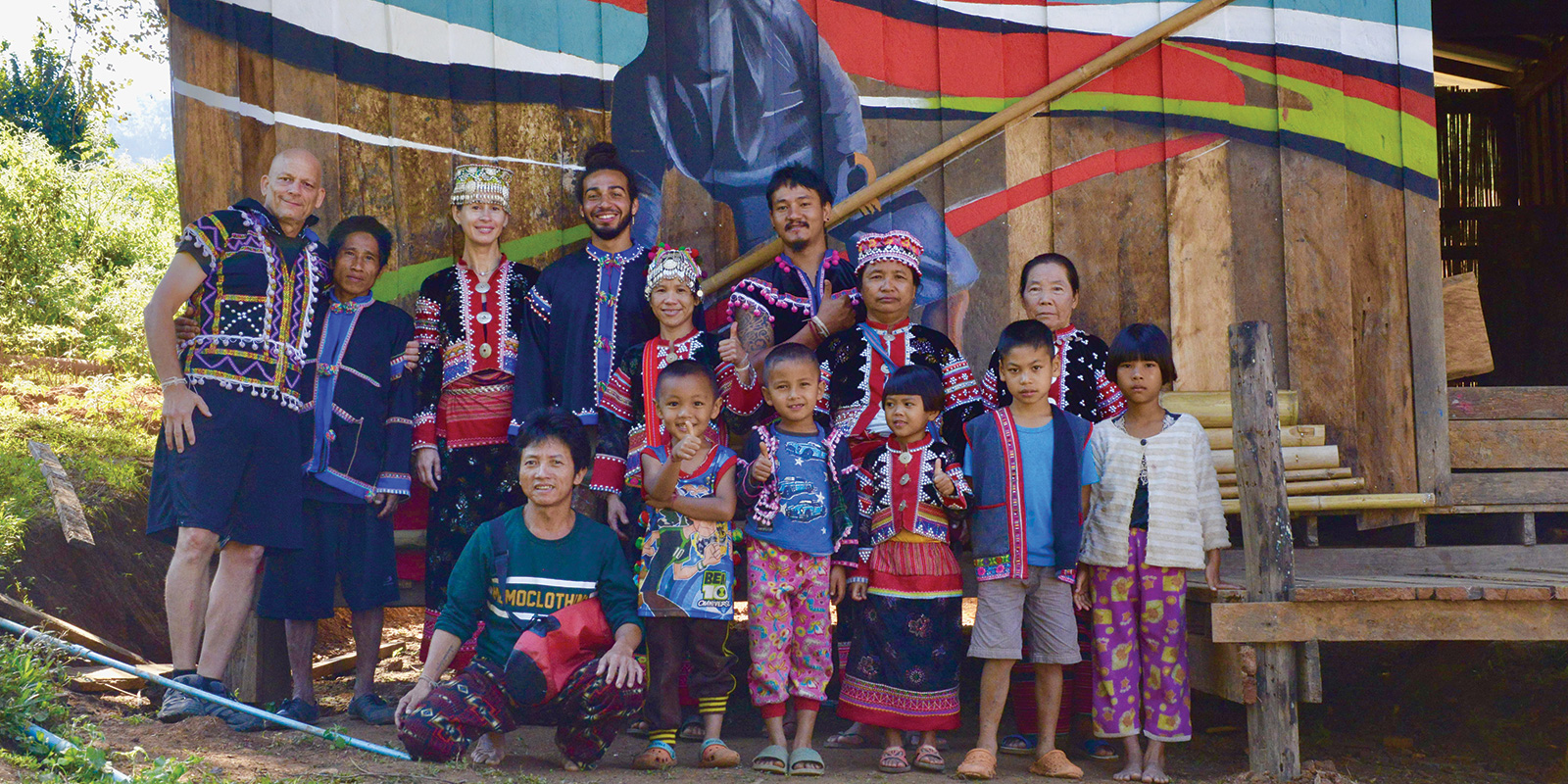
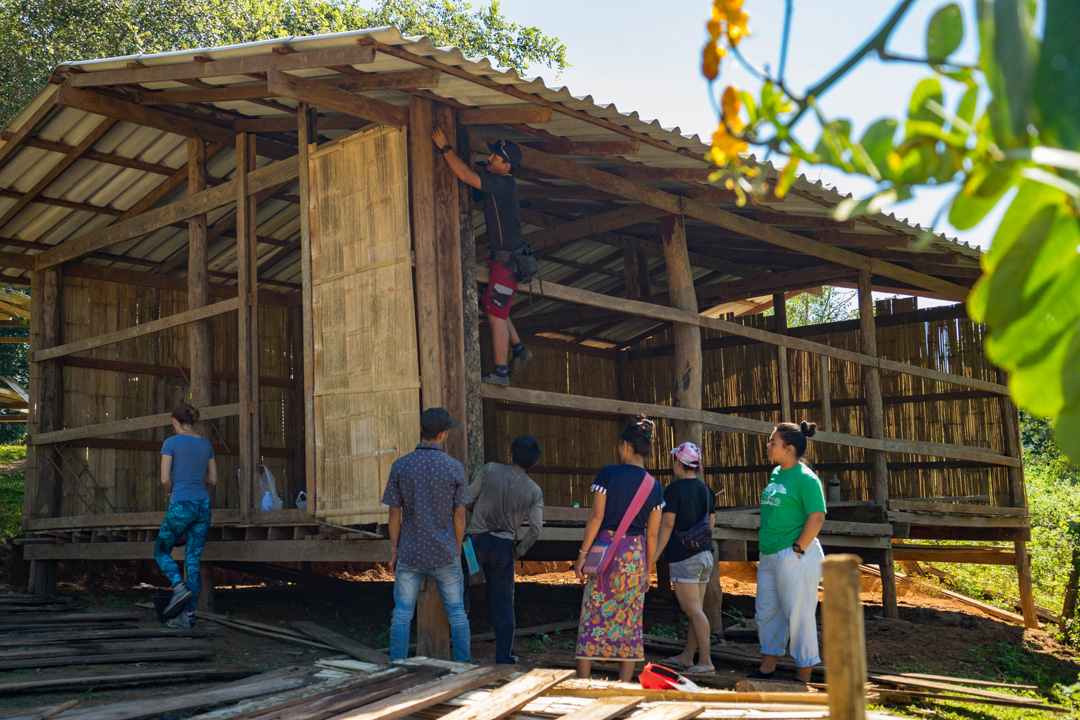
A year later, another tragic accident, the second in 8 years. A new focus on trying to help people, to carry on the legacy of Jonathan. In November 2018, we went to Pong Ngan, Thailand, another Give location. It is out in the middle of nowhere, in the jungle outside of Chiang Mai, Thailand. Prior to leaving, with lots of support from friends and family, we raised the money to build a small community center there, in honor of Jon. It was constructed through Give, by the Lahu Tribe. Jon’s good friend, Rey Jaffet, was going to paint a mural on the community center. 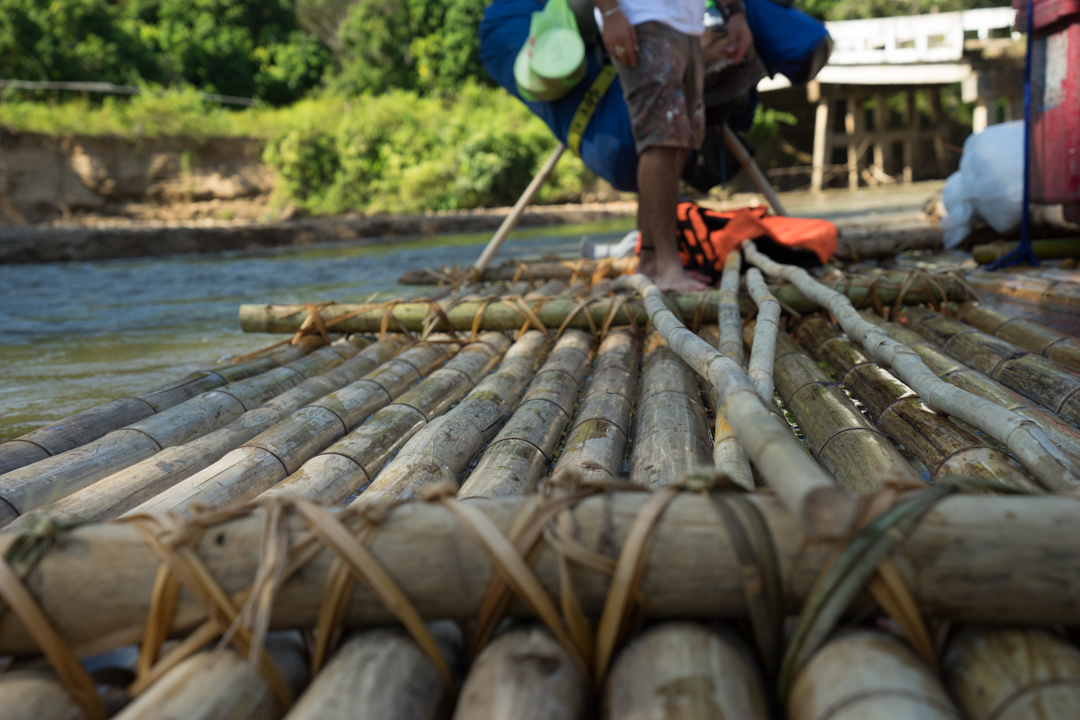
We arrived after a 26-hour flight, a two-and-a-half-hour drive outside of the city, a one-and-a-half-hour drive on bumpy rutted 4 x 4 jeep trails, culminating in a one-and-a-half-hour bamboo raft trip down stream. The bamboo raft was made by hand, as we waited, by one of the Lahu people. Twenty minutes after we arrive, standing in front of the little community center up walks this young woman. She speaks no English, had no idea what had been painted by Rey in the past, and knew virtually nothing about us. Guess what her shirt said? “We Are One”. What’s noteworthy about that? We Are One was also the main center piece of the huge mural, A Declaration of Hope, that Rey had recently painted in Miami. There is no possible way that this young woman new about that mural.
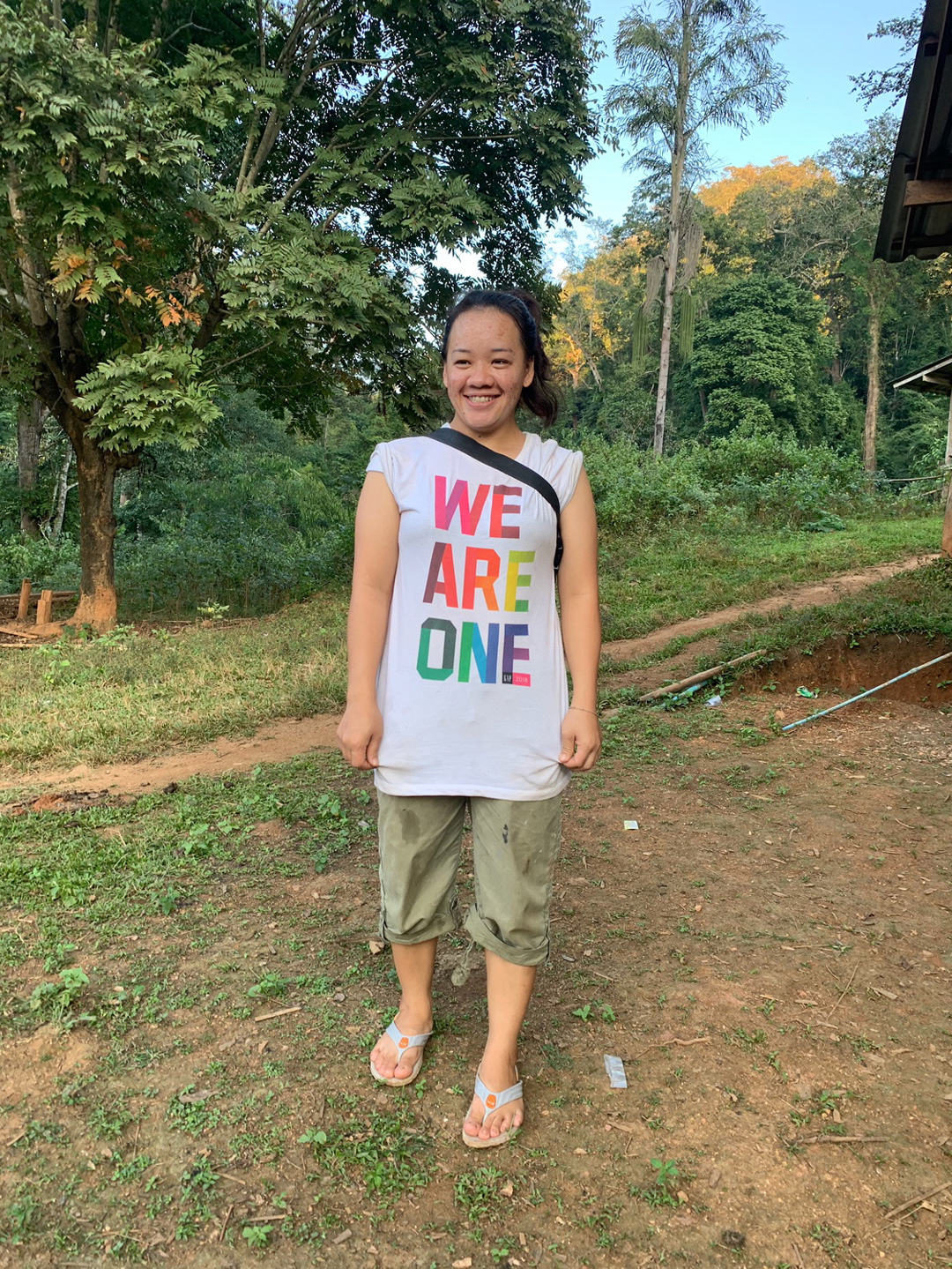
The synchronicity was amazing, wonderful, and chilling all at one time. We truly are one. Somehow like birds in a flock, or fish in a school, bees in a swarm, we are all connected. Whether telepathically, a collective conscience or through a higher power, or all three together - We Are One.
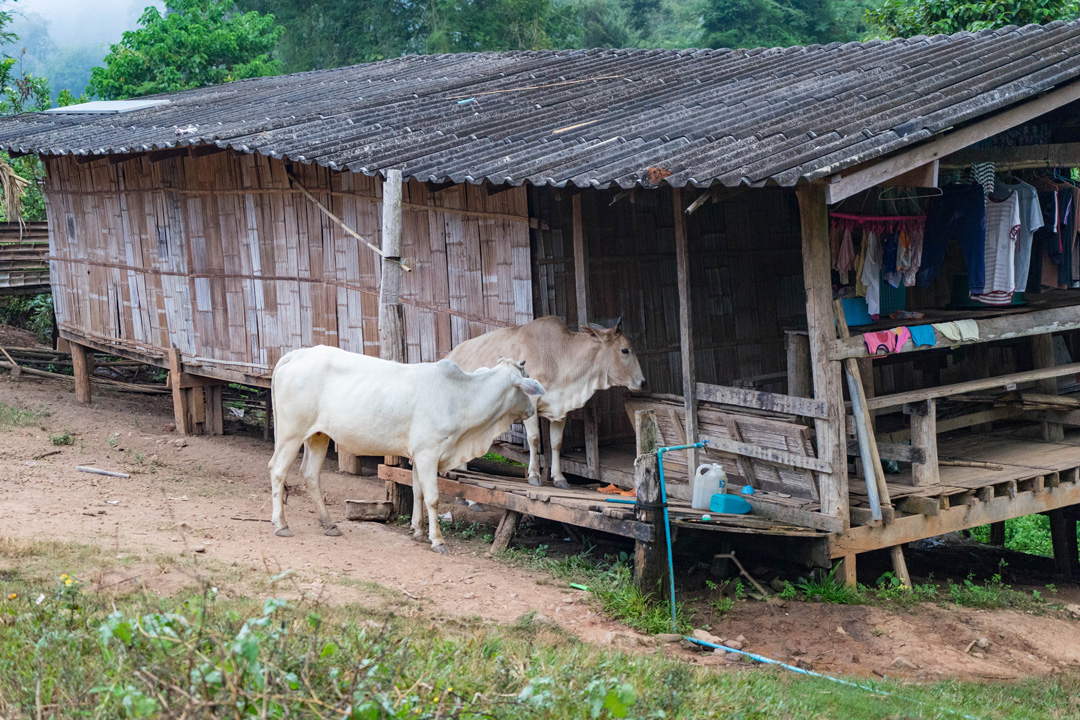
The Lahu people were warm and welcoming. Their tiny village, a throwback to another time. In many ways a simpler, better time. A juxtaposition of old world jungle living, in bamboo and wood huts, with no electricity. Running water provided the way the Romans did, by diverting a stream higher on up the hill through pipes, to each home. However, most adults had a cell phone and walked up to the top of the hill to receive a cell phone signal to stay in touch with the outside world. Cows, pigs, chickens and dogs all roamed freely about, with water buffalos leery of humans, and us of them, no more than a stone’s throw away.
The Lahu people are a small marginalized Hill Tribe. Originally from Myanmar (Burma) they are no longer welcome there, and they are staunchly trying to resist being assimilated into mainstream Thai culture. They have their own language, though many also spoke Thai. There is a concern that this language will die out, as the younger children learn Thai and in some cases English. The Lahu language is not a written language, strictly an oral tradition. Unless something is done to document their language, it may soon be gone.

At 5 or 6 years old, a Lahu boy would receive his first machete, a tool they learn to use expertly, and they carry with them on their hip, daily. The way they weld the machete is more like an extension of their hand than a separate tool. Used to cut lumber, split bamboo, or slaughter an animal, it is a multi-purpose tool. Unlike some machete’s, these are fiercely sharp, but also carry a substantial weight. The bamboo that grows around the village is almost as important as air. It is used to make the afore mentioned rafts for traveling the river. They spilt it finely into half inch strips, somehow making a round bamboo trunk into a flat piece of building material used to make the siding on their homes. It also cleverly stays somewhat together in areas, the fibrous plant material clinging to each other, to make a more substantial siding.
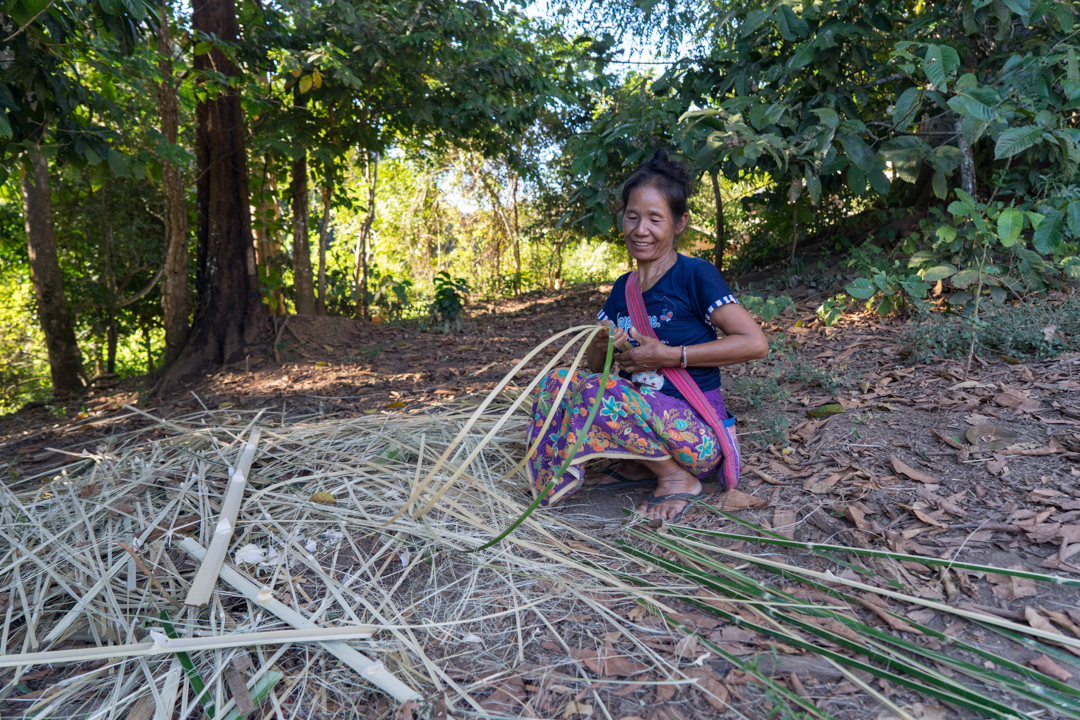
It protects the inhabitants from the more severe elements, but also allows a natural air movement cooling and circulating the air, and the bugs! They cook a delicious sticky rice inside the hollow bamboo stalks. They use fine stripes of it, soaked in water, to then lash together the materials for the homes and the rafts. When they dry out they become tight, and very strong. The material is ubiquitous, and well used.
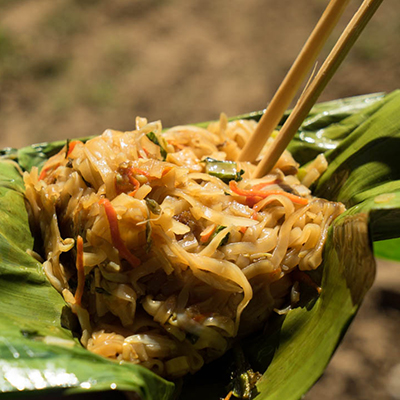
At one point when we stopped for lunch prior to rafting to the village, we were preparing to eat a tasty Pad Thai, wrapped in a banana leaf, another wonderful prevalent plant. It quickly became apparent that someone had forgotten to bring the standard eating utensil in Thailand, the spoons. Tony our guide, and soon to become our friend, instructed his younger brother brusquely to do something. Mooky, a wonderful Thai woman, working for Give, explained that Tony had told his brother to make us chopsticks with bamboo. We watched as he carefully split bamboo, and removed splinters from the material.

Tony quickly assisted and in no time, before the Pad Thai could even get cold we had 5 sets of chopsticks and were enjoying a wonderful lunch. Fast food take out, at its best.

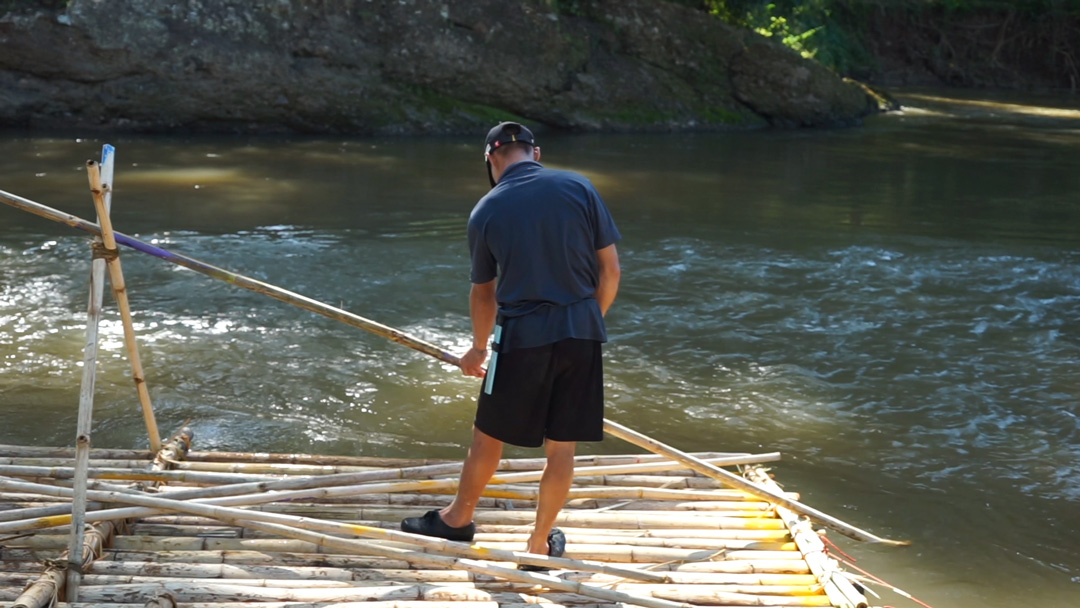
Rey did a wonderful job on painting the mural. He used as his model, Tony’s brother, poling the bamboo raft downstream. They actually were amazing to watch, guiding the raft, all the while casting with a small fishing pole, similar to fly casting, the hook barely touching the water, to be pulled back in quickly, mimicking the action of a bug landing on the water.

The bait they used was similar to a small red berry, smaller than a pea, but actually a relative of the eggplant. At one point the main raft man, the one that built the raft, caught a fish, the raft went around a corner, and came up to a series of small rapids. Nothing major, but a challenge when you have a bamboo pole, a fishing pole and a fish in your hands. He thought quickly, shoved the fish in his mouth to hold it, then dexterously guided through the rapids. After the rapids, he took out a thin piece of bamboo lashing, fed it through the fish’s mouth, out his gills and tied it under the raft, in the water to keep the fish fresh and alive until we arrived. They caught several more on the way down. Rey and Tony enjoyed them for dinner the next day.
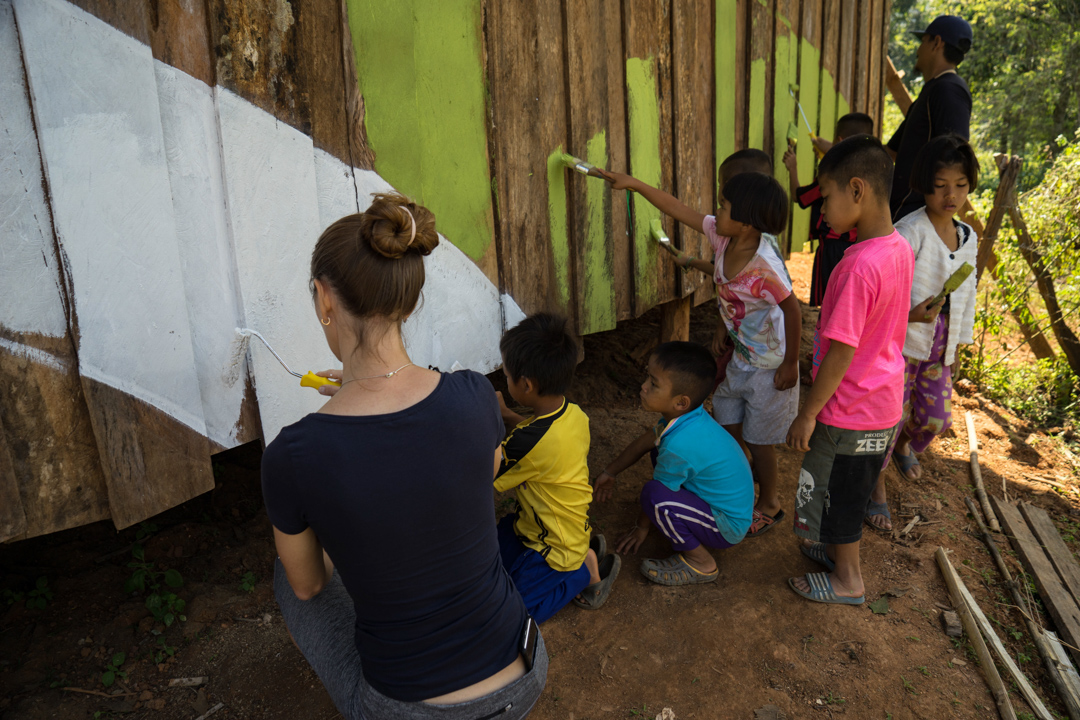
Almost the whole village pitched in to complete the community center, and then to paint it. The children all had paint brushes, the woman brought by snacks, one time my favorite, a mango sticky rice steamed in a banana leaf. Perhaps it was the fresh air, the hard work, the wood smoke, and the allure of the jungle, but it was the best sticky rice I ever had. All the while a strange haunting melody was being played, sung in Lahu, sounding like it had been recorded in the 1920’s and played on an old scratchy Victrola. In fact, I think it was played on a cell phone, through small cheap speakers but the effect was magic, none the less. The accommodations in Pong Ngan were far from luxurious, though clean, and the food was wonderful.
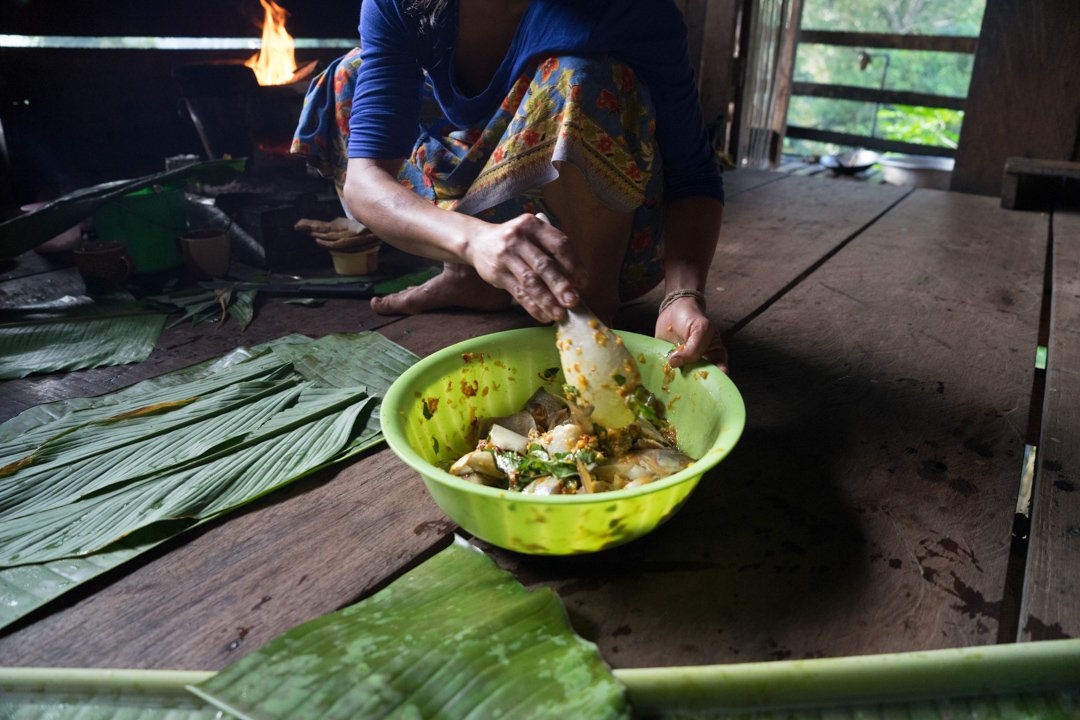
Fresh and prepared quickly, with skill, by Tony’s aunt. But the hospitality was certainly top shelf. The moonshine rice whisky, supplied by Tony’s step dad, was not top shelf, but it was cheap and seemed guaranteed to kill anything that would ail you! I enjoyed more than my fair share of it, and know why they call it white lighting.
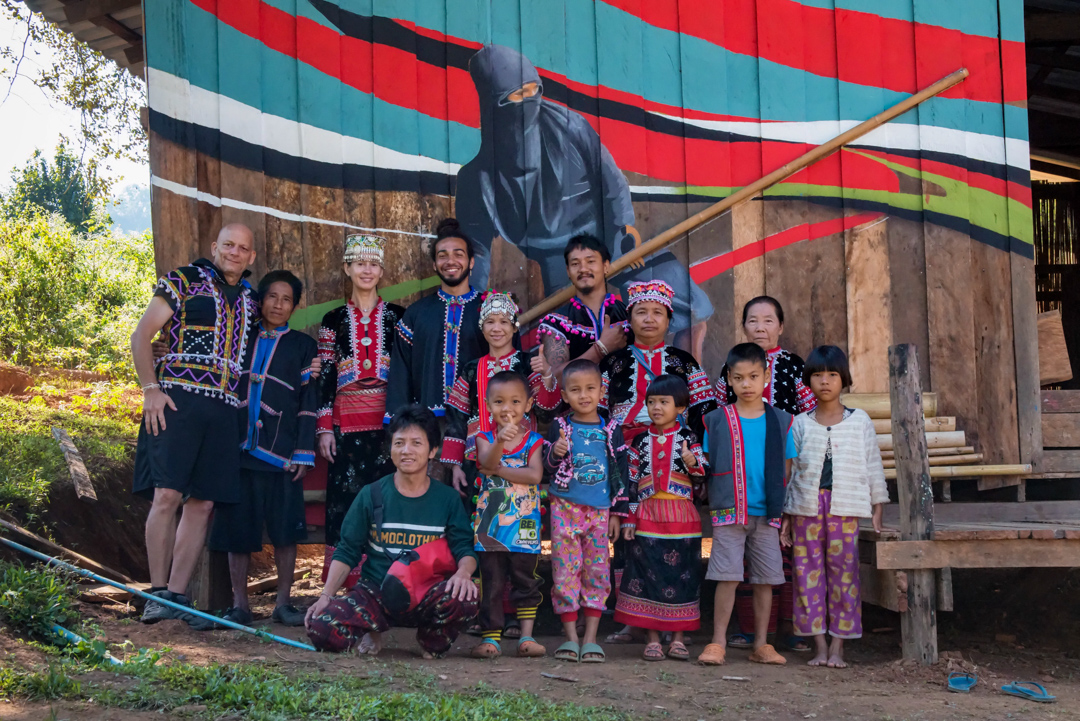
If you ever have the chance to have a home stay, anywhere, take it. If you have the chance to go to Thailand make sure you make an effort to visit the Lahu Hill Tribe, and tell them Jonathan’s dad sent you. We hope to be back soon.